
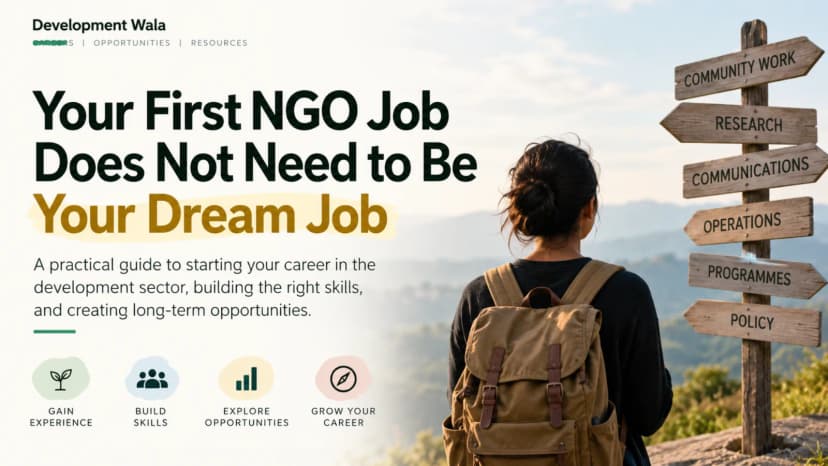
Your First NGO Job Does Not Need to Be Your Dream Job
Starting a career in the development sector can be confusing.

You search for NGO jobs, fellowships and social impact opportunities, and quickly find yourself comparing your profile with people who already have years of experience.
You may start thinking:
“Should I wait for the perfect job?”
“Do I need a Master's degree first?”
“Will an internship really help?”
“Should I only apply for programme roles?”
The reality is that development sector careers rarely follow a straight line.
Your first NGO job does not need to be your dream job.
It needs to help you learn, build relevant skills and understand the sector better.
Start by understanding the development sector
The development sector is much broader than many students realise.
There are organisations working across education, public health, livelihoods, gender, climate change, rural development, social protection, migration, disability, humanitarian response, governance and many other areas.
There are also very different types of roles.
You could work in:
Programme implementation
Research
Monitoring and Evaluation
Community engagement
Fundraising
Communications
Human Resources
Finance
Operations
Policy
Partnerships
Administration
Technology and data
This means you do not necessarily need to start your career in a role with “development” or “social impact” in the job title.
The important question is whether the experience is helping you build skills that are relevant to the kind of career you want.
Your first role is an opportunity to learn how organisations actually work
University can teach you theories, frameworks and concepts.
But working inside an organisation teaches you something different.
You begin to understand how programmes are planned.
How teams work with communities.
How organisations communicate with government and other stakeholders.
How budgets and reporting work.
How field realities can differ from programme plans.
How decisions are made.
These experiences can become extremely valuable later in your career.
A role that looks small on paper can sometimes give you more practical exposure than a prestigious title with very little responsibility.
Do not underestimate non-programme roles
One common mistake among early-career professionals is assuming that they must start with a programme role.
That is not necessarily the case.
An HR role can teach you how social sector organisations recruit and manage people.
A communications role can teach you how organisations build public engagement.
An operations role can give you an understanding of how programmes are supported behind the scenes.
A research role can strengthen your analytical and writing skills.
A fundraising role can teach you how organisations build financial sustainability.
These skills can later help you move into other parts of the sector.
Your career does not have to be decided by your first job title.
Look at what you are learning, not only what you are earning
Salary obviously matters.
But particularly at the beginning of your career, it is also worth asking what an opportunity will teach you.
Before accepting a role, consider:
Will I get meaningful responsibilities?
Will I work with experienced professionals?
Will I interact with communities or stakeholders?
Will I learn new technical or professional skills?
Will I have opportunities to take ownership of work?
Will this experience help me understand which part of the sector I want to pursue?
Will I have something concrete to show on my CV after six or twelve months?
These questions can help you look beyond the job title.
Build evidence of your work
One of the most useful things you can do early in your career is document what you actually contribute.
Do not simply write:
“Worked on an education programme.”
Try to understand what you actually did.
Did you conduct field visits?
Did you organise workshops?
Did you analyse data?
Did you coordinate with government officials?
Did you prepare reports?
Did you support beneficiaries?
Did you manage volunteers?
Did you develop communication material?
Did you improve an internal process?
The more clearly you can explain your contribution, the easier it becomes to demonstrate your experience when applying for your next opportunity.
Your career will probably not be linear
Many development professionals move between different types of organisations and roles.
Someone may begin with an NGO, move into research, work with a government programme, pursue a fellowship and later join an international organisation.
Someone else may start in communications and eventually move into programme management.
Another person might begin in fieldwork and later specialise in monitoring and evaluation.
There is no single route into the development sector.
What matters is understanding where you are now, what you are learning and what you want to build towards.
Do not wait forever for the “perfect” opportunity
Of course, you should be thoughtful about the roles you apply for.
But waiting indefinitely for the perfect job can also slow down your learning.
If you find an opportunity that gives you relevant exposure, supportive colleagues and meaningful responsibility, it may be worth considering even if the title is not exactly what you imagined.
Your first opportunity is not a lifetime commitment.
It is one step in a much longer career.
A simple way to think about your first NGO job
Instead of asking:
“Is this my dream job?”
Ask:
“Will this experience make me better prepared for my next opportunity?”
If the answer is yes, there may be value in taking that step.
Learn from the role.
Build relationships.
Develop your skills.
Understand the sector.
Document your work.
Then use that experience to decide where you want to go next.
The development sector needs people with different backgrounds, skills and experiences.
You do not need to have your entire career figured out before you begin.
Sometimes, you just need to take the first meaningful step.
Start exploring development sector opportunities
If you are looking for jobs, fellowships, internships, scholarships and other opportunities in the development sector, explore the opportunities available on DevelopmentWala.org.
You can also use the platform to discover organisations, career resources and opportunities relevant to your interests.
Your first role may not be your dream job.
But it could be the role that helps you discover what your dream career actually looks like.
Written by
More from the blog

AI and Development Careers: The Skill Combination to Watch in 2026
AI is changing development sector careers in 2026. Learn which AI skills, human skills and practical capabilities can help you stay competitive.
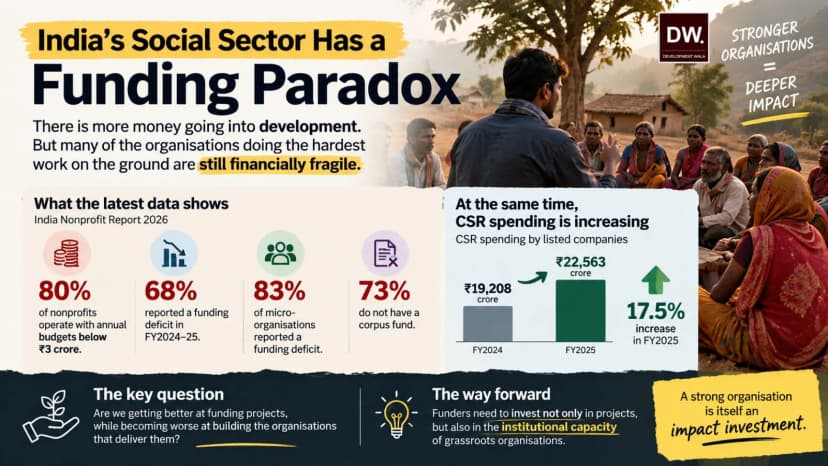
India’s social sector has a funding paradox
India’s social sector is seeing more CSR money, but grassroots NGOs remain financially fragile. 80% of nonprofits operate with budgets below ₹3 crore, 68% reported funding deficits, and 73% have no corpus fund.
Comments (0)
No comments yet. Start the conversation.