
AI and Development Careers: The Skill Combination to Watch in 2026
AI is changing development sector careers in 2026. Learn which AI skills, human skills and practical capabilities can help you stay competitive.


Artificial intelligence is no longer something that development professionals can treat as a future technology.
It is already changing how people work across the global development sector.
From writing reports and analysing data to monitoring programmes, preparing proposals and supporting operations, AI tools are increasingly becoming part of everyday professional work.
A recent Devex survey found that almost 83% of development professionals surveyed said they use AI sometimes or always in their work. Writing and editing were the most common uses, followed by data analysis and workflow automation.
At the same time, AI adoption across organisations remains uneven.
This creates an interesting situation for students and young professionals entering the development sector.
You do not necessarily need to become an AI engineer.
But understanding how AI can support your existing professional skills is becoming increasingly valuable.
The real opportunity may be at the intersection of AI and development expertise.
Why AI Is Becoming Important for Development Careers
The development sector has always depended heavily on information.
Professionals spend significant amounts of time reading research, preparing reports, analysing data, writing proposals, documenting programmes, communicating with stakeholders and managing large amounts of information.
Many of these activities involve tasks that AI tools can now support.
For example, a programme officer might use AI to organise research before beginning a report.
An M&E professional might use AI to explore a large dataset and identify patterns that require further investigation.
A communications professional might use AI to develop initial drafts for newsletters or campaign materials.
A researcher might use AI to organise literature and compare themes across documents.
A project manager might use AI to structure meeting notes, identify action points and prepare project documentation.
The important point is that AI is often supporting existing work rather than creating an entirely new category of work.
This is why AI literacy is increasingly becoming relevant across development roles.
Devex reported in February 2026 that AI skills were increasingly becoming an expectation for global development roles, even when AI was not part of the job title.
For someone starting a career in the sector, this changes the skills equation.
Your degree still matters.
Your understanding of development issues still matters.
Your field experience still matters.
But knowing how to use technology effectively can make those existing capabilities more valuable.
AI Skills Development Professionals Should Start Building
You do not need to learn everything about artificial intelligence.
Instead, focus on practical skills that connect directly with the work you want to do.
1. AI Literacy
The first skill is simply understanding what AI can and cannot do.
You should know how generative AI tools work at a basic level, what kinds of tasks they are good at and where they are likely to produce unreliable results.
This is more important than memorising dozens of tools.
A development professional should be able to look at a task and ask:
Can AI help me do this faster?
What information should I provide?
How do I check the result?
What risks could this create?
What part of the decision still requires human judgement?
That basic level of AI literacy is becoming increasingly relevant during recruitment.
Recent discussions among development employers and recruiters suggest that basic knowledge of AI tools is increasingly expected across roles and functions.
2. Prompting and AI Assisted Research
Knowing how to communicate clearly with AI tools is becoming a useful professional skill.
But good prompting is not simply about writing long instructions.
It is about understanding the task first.
For example, instead of asking an AI tool to write a report, a development professional might provide the programme context, target audience, available evidence, desired structure and limitations.
The professional then reviews and improves the output.
This approach can make AI useful for research, brainstorming, summarising documents, preparing interview questions and developing initial drafts.
The important skill is not getting an impressive answer from AI.
It is knowing whether the answer is actually useful.
3. Data Analysis and Visualisation
Data skills are becoming particularly important.
According to the recent Devex survey, 61% of respondents who answered the relevant question said they use AI for data analysis.
This does not mean every development professional needs to become a data scientist.
But being comfortable with spreadsheets, dashboards, basic statistics and data visualisation can become much more valuable when combined with AI.
Imagine a programme officer who can work with Excel, Power BI or another analytics platform and also use AI to help explore a dataset.
That combination can be more useful than knowing either skill in isolation.
The same applies to monitoring and evaluation.
AI can help identify patterns, organise information and support analysis, but the professional still needs to understand indicators, methodology, programme context and limitations.
4. Programme Design
AI is also beginning to influence how programmes are designed.
Development professionals may use AI to help brainstorm intervention ideas, analyse stakeholder information, structure theories of change or identify questions that require further investigation.
However, programme design cannot simply be handed over to a chatbot.
A programme operates within a social, political, economic and cultural context.
AI does not replace conversations with communities.
It does not replace field visits.
It does not replace understanding local institutions.
And it certainly does not replace accountability to people affected by a programme.
The strongest professionals will therefore be those who can combine technological tools with genuine contextual understanding.
5. Monitoring and Evaluation
Monitoring and evaluation is another area where AI is creating new possibilities.
AI can assist with organising qualitative information, identifying recurring themes, summarising large volumes of feedback and supporting data analysis.
But there is a major difference between finding a pattern and understanding what that pattern means.
An M&E professional needs to understand methodology, sampling, indicators, attribution, data quality and context.
AI can support the analysis.
It should not become the analyst.
The Human Skills That May Become More Valuable
There is an interesting contradiction emerging from the AI conversation.
As technology becomes more capable, some human skills may become more important rather than less important.
Development professionals need to work with communities, governments, donors, researchers, NGOs and international organisations.
This requires judgement, communication and relationship building.
Recent discussions among development sector leaders have highlighted critical thinking, intellectual humility and ethical reasoning as increasingly important capabilities in an AI enabled workplace.
This matters because AI can produce an answer very quickly.
It cannot automatically tell you whether the answer makes sense in a particular community.
It cannot automatically recognise every political or cultural sensitivity.
It cannot replace professional accountability.
It cannot decide what is ethically appropriate in every situation.
That means development professionals should not think about AI skills and human skills as competing categories.
They should develop both.
What Should Students Learn First?
If you are a student or recent graduate, do not feel that you need to learn everything about AI at once.
Start with AI literacy. Understand how generative AI tools work, what they are good at, where they can make mistakes and how to verify their outputs. You should be able to use AI confidently without blindly trusting everything it produces.
Then learn how to write better prompts and use AI for practical tasks such as research, summarising information, brainstorming, drafting and organising your work. The aim is not to become an expert in prompting. It is to learn how to use AI as a useful professional tool.
Data skills should also be high on your list. Learn Excel, basic statistics and data visualisation. If you are interested in monitoring and evaluation, research, policy or programme management, these skills can become particularly valuable when combined with AI assisted analysis.
Do not overlook research and evidence skills. Learn how to find credible sources, assess evidence, synthesise information and communicate findings clearly. AI can help with parts of this process, but you still need to know whether the information is reliable and relevant.
If you want to work in the development sector, learn the basics of monitoring and evaluation as well. Understand indicators, theories of change, programme frameworks and evaluation methods. These are sector skills that technology does not replace.
Communication is equally important. Writing, presentation, stakeholder communication and the ability to explain complex ideas clearly remain valuable across development roles.
Finally, learn about responsible AI use. Understand issues around privacy, bias, misinformation and sensitive data. Development professionals often work with vulnerable communities and personal information, so knowing when not to use an AI tool is just as important as knowing how to use one.
The goal is not to become an AI specialist.
The goal is to become a development professional who understands AI, uses it responsibly and knows how to combine it with strong research, data, programme and people skills.
AI + Development Expertise Could Become a Powerful Combination
Consider two candidates applying for a programme role.
Candidate A understands development theory, has some programme experience and can produce reports manually.
Candidate B has similar development knowledge but can also use AI tools responsibly, analyse data, improve workflows and critically evaluate AI generated outputs.
The second candidate may have an advantage because they can combine sector knowledge with technology.
This is already reflected in conversations among development employers.
Recent Devex reporting suggests that organisations are looking for people who can work with AI while also bringing judgement, curiosity and strong human skills.
This does not mean that everyone needs to add “AI expert” to their CV.
It means you should start thinking about how AI can strengthen the professional identity you are already building.
For example:
A researcher who learns AI assisted research.
An M&E professional who learns AI supported data analysis.
A communications professional who learns AI assisted content workflows.
A programme manager who learns AI supported project management.
A policy professional who learns how to use AI for evidence synthesis.
A social worker who understands how AI can support administration while protecting sensitive information.
The combination is what matters.
How to Show AI Skills on Your CV
Simply writing “AI” under your skills section is unlikely to tell an employer much.
Try to demonstrate how you have actually used it.
Instead of:
AI tools
You could describe a practical example:
Used AI assisted research and data analysis to support programme documentation and reporting.
Or:
Developed an AI supported workflow for organising research, drafting content and reviewing programme documentation.
The exact wording should reflect what you have genuinely done.
Do not exaggerate your experience.
If you have only completed an online course, say so.
If you have experimented with AI tools during university projects, describe that experience accurately.
If you have used AI in a professional setting, explain the task and the outcome.
Employers need evidence that you can apply a skill, not simply recognise its name.
Do Not Forget Data Privacy and Ethics
This may be one of the most important parts of learning AI for development work.
Development professionals often work with sensitive information.
This can include personal information, beneficiary data, case records, health information, financial information and information about vulnerable communities.
Putting sensitive information into an AI system without understanding how that system handles data can create serious risks.
The development sector therefore needs professionals who understand responsible use, not just productivity.
Before using an AI tool, ask whether the information is appropriate to share.
Check your organisation's policies.
Remove unnecessary personal information.
Understand the tool you are using.
And always review AI generated content before it reaches a client, community, donor or decision maker.
Being able to use AI responsibly may become just as important as being able to use it efficiently.
AI Will Not Make Development Expertise Irrelevant
There is a lot of anxiety around AI and employment.
Some of that concern is understandable.
AI will change tasks.
Some workflows will become faster.
Some responsibilities may require fewer hours.
Some entry level tasks may be automated.
But that does not mean development expertise becomes irrelevant.
In fact, recent discussions among development leaders suggest the opposite.
Lindsey Moore of DevelopMetrics told Devex that organisations still need people with deep sector expertise, including specialists in monitoring and evaluation and health, because AI cannot replicate that depth of understanding.
This is an important lesson for students.
Do not abandon development knowledge because AI is growing.
Build stronger development knowledge and learn how to use AI alongside it.
Understand communities.
Understand policy.
Understand programmes.
Understand data.
Understand research.
Then learn how technology can help you work better.
A Practical 90 Day Plan for Students and Young Professionals
If you want to start developing these skills, you do not need an expensive course immediately.
Start with practical work.
Month 1: Learn the Basics
Understand how generative AI works.
Experiment with a few tools.
Learn how to write clear prompts.
Learn how to verify information.
Practise using AI for research, writing and summarisation.
Most importantly, learn where AI tends to make mistakes.
Month 2: Connect AI With Your Career
Choose your area of interest.
If you want to work in M&E, practise analysing datasets and creating insights.
If you want to work in policy, practise evidence synthesis and policy research.
If you want to work in communications, experiment with content workflows.
If you want to work in programme management, explore project documentation and workflow automation.
Make the learning relevant to the job you actually want.
Month 3: Build Evidence
Create two or three small projects that demonstrate what you have learned.
For example, you could analyse a publicly available development dataset, create a simple dashboard, prepare a short policy brief using an AI assisted research workflow or develop a programme monitoring framework.
Then document the process.
This gives you something much stronger than simply listing AI on your CV.
You have evidence.
The Future Skill Combination
The development professional of the future may not fit neatly into the categories we use today.
A programme manager may need data skills.
A researcher may need AI literacy.
An M&E professional may need automation skills.
A communications professional may need to understand AI generated content.
A policy professional may need stronger data capabilities.
And everyone will still need judgement.
The current evidence suggests that AI adoption is already widespread among individual development professionals, even though many organisations have not yet fully integrated these tools.
That gap creates an opportunity.
People who start learning now can experiment before these capabilities become completely standard.
You do not need to predict exactly which tool will dominate the next five years.
You need to become comfortable learning new tools while keeping your core professional skills strong.
Conclusion
AI is becoming part of the development sector.
The question for students and young professionals is no longer whether they should learn about it.
The more useful question is how they can combine AI with the skills they already want to build.
If you want to work in NGOs, international development, public policy, research, M&E or social impact, start developing your AI literacy alongside your sector expertise.
Learn the tools.
Learn their limitations.
Protect sensitive information.
Question the outputs.
And keep building the human skills that technology cannot easily replace.
The strongest development professionals may be those who can sit comfortably at the intersection of technology, evidence and people.
Start there.
Written by
More from the blog
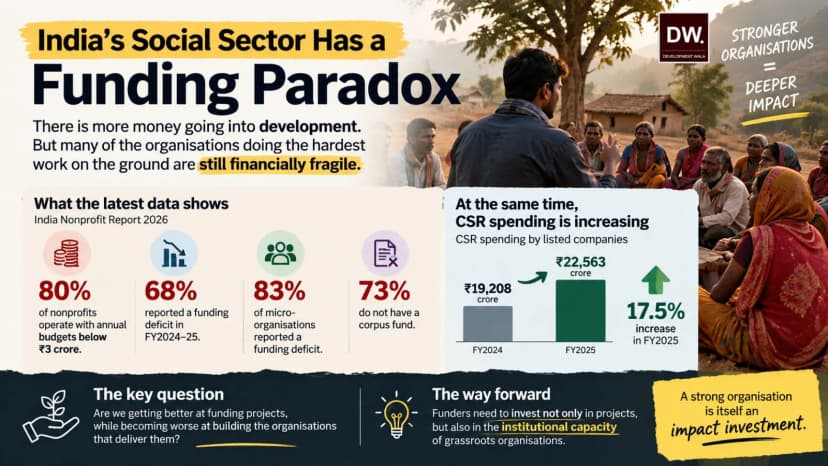
India’s social sector has a funding paradox
India’s social sector is seeing more CSR money, but grassroots NGOs remain financially fragile. 80% of nonprofits operate with budgets below ₹3 crore, 68% reported funding deficits, and 73% have no corpus fund.
Comments (0)
No comments yet. Start the conversation.