
India’s social sector has a funding paradox
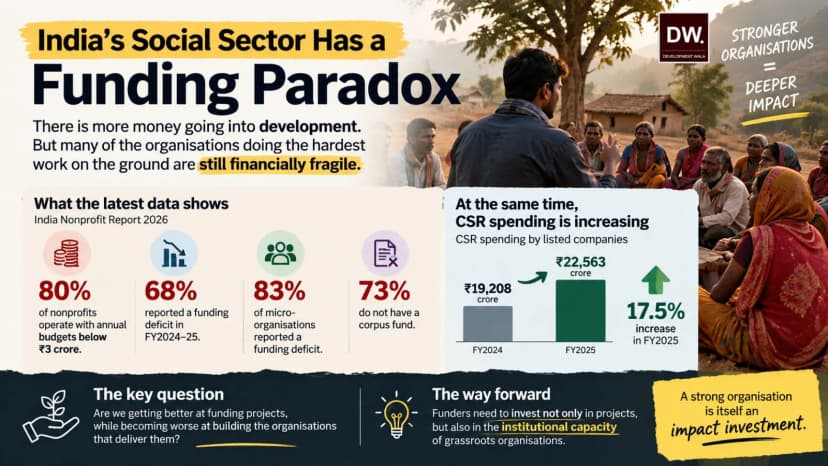
India’s social sector is seeing more CSR money, but grassroots NGOs remain financially fragile. 80% of nonprofits operate with budgets below ₹3 crore, 68% reported funding deficits, and 73% have no corpus fund.

India’s social sector is experiencing something that, at first glance, looks like good news.
CSR spending is rising.
Corporate participation is increasing.
More companies are talking about impact, sustainability and social responsibility.
But at the same time, many of the organisations closest to communities continue to operate with very limited financial security.
That is the paradox.
We may be getting better at funding social projects without necessarily getting better at building the institutions that deliver them.
More money is entering the system
India’s CSR ecosystem has expanded considerably over the past decade.
According to CRISIL, listed companies spent ₹22,563 crore on CSR in FY2025, up approximately 17.5% from ₹19,208 crore in FY2024.
The number of companies reporting CSR expenditure also increased by 20%, reaching 2,013.
Education and skill development received the largest share, at ₹9,182 crore, while healthcare and sanitation received ₹5,386 crore.
There was also significant growth in areas such as environmental initiatives and rural development.
On the surface, this looks encouraging.
But looking only at the total amount of money entering the system misses an important question:
Where is the money going, and what kind of organisations are able to access it?
The organisations closest to communities are often the most financially vulnerable
The India Nonprofit Report 2026, based on a survey of 438 nonprofits and interviews with more than 25 experts, provides an important view of what is happening inside the sector.
80% of surveyed nonprofits operate with annual budgets below ₹3 crore.
68% reported a funding deficit in FY2024–25.
Among micro-organisations, the figure rises to 83%.
And 73% of nonprofits reported that they do not have a corpus fund.
Perhaps most importantly, 90% identified funding and financial sustainability as their primary challenge.
This tells us something important about the structure of the sector.
The organisations working closest to communities are not necessarily the organisations with the strongest financial infrastructure.
In fact, the opposite can often be true.
A small organisation may have deep relationships with a community, years of local knowledge and considerable trust among beneficiaries.
But it may not have a dedicated fundraising team, sophisticated monitoring systems, a large finance department or the administrative capacity required by increasingly complex funding processes.
That creates a strange situation.
The organisation may have strong social capital but weak financial capital.
The geography of funding is another problem
India’s development challenges are not evenly distributed.
Neither is CSR funding.
CRISIL’s analysis found that, in FY2024, only 397 of 2,020 qualifying companies implemented projects in aspirational districts.
That is roughly 20% of the companies analysed.
Those projects accounted for ₹2,390 crore, or around 12% of total CSR spending.
The latest CRISIL analysis also found that in FY2025, only 373 companies reported CSR expenditure in aspirational districts, accounting for around 10% of total CSR spending.
This matters because the places with the greatest development challenges are often the places where organisations have the greatest difficulty attracting resources.
It is easier to find organisations, consultants, vendors and implementation infrastructure in major cities.
It is much harder to build and sustain these ecosystems in remote districts.
And this is where the conversation about institutional capacity becomes important.
The NGO question is becoming more complicated
There is another significant shift taking place.
Corporates are increasingly building their own capacity to implement CSR programmes.
CRISIL found that the number of companies using implementing agencies declined substantially between FY2020 and FY2024.
In 2020, 1,082 companies used implementing agencies.
By FY2024, that number had fallen to 566.
CRISIL also reported that only 28% of qualifying companies used implementing agencies in FY2024, while 54% managed CSR activities themselves.
There are understandable reasons for this.
Companies want greater control.
They want stronger monitoring.
They want clearer reporting.
They want measurable outcomes.
And, importantly, CRISIL itself reports that stakeholders see a shortage of sufficiently capable NGOs, particularly in rural areas.
So this is not simply a story about corporates abandoning NGOs.
There is a legitimate capacity problem within parts of the nonprofit ecosystem.
But there is another question worth asking:
If NGOs lack capacity, who is investing in building that capacity?
Compliance is not the same as capacity
A small NGO can be excellent at community mobilisation and still struggle with financial reporting.
It can understand local livelihoods extremely well and still have a weak monitoring and evaluation system.
It can have deep relationships with tribal communities and still struggle to produce the kind of documentation required by a large corporate donor.
These are not necessarily failures of mission.
They are often consequences of organisational maturity and resource constraints.
Yet funding systems frequently treat them as the same thing.
We ask organisations to demonstrate governance, compliance, monitoring, impact measurement, safeguarding, financial controls, technology adoption and professional reporting.
All of these things matter.
But building them requires money.
It requires people.
It requires time.
And it requires funders who are willing to support organisational development rather than only project activities.
The hidden cost of project-based funding
Imagine an NGO receives funding for a two-year livelihoods programme.
The grant pays for training 1,000 farmers.
It pays for workshops.
It pays for field visits.
It pays for programme staff.
It pays for reporting.
But what happens to the organisation itself?
Who pays for upgrading its financial systems?
Who trains its leadership team?
Who builds its fundraising capacity?
Who develops its digital infrastructure?
Who creates a proper HR system?
Who helps the organisation build a reserve for the period between two grants?
These things may not appear directly in an impact dashboard.
But without them, the organisation may struggle to survive long enough to create sustained impact.
This is why organisational capacity should not automatically be treated as an overhead.
Sometimes the capacity of the organisation is itself part of the intervention.
What should funders do differently?
There is no single answer.
Unrestricted funding is not automatically better funding.
NGOs also have a responsibility to strengthen governance, financial management, monitoring, leadership and accountability.
But funders can think differently about what they are financing.
Instead of asking only:
“What activities will this grant fund?”
They can also ask:
“What capabilities will this organisation need to deliver its mission five years from now?”
That could mean longer funding cycles.
More flexible funding.
Core institutional support.
Investment in technology and data systems.
Leadership development.
Staff training.
Fundraising support.
Better monitoring and evaluation systems.
And, importantly, funding that allows organisations to build reasonable reserves.
The goal should not be to create NGOs that are permanently dependent on grants.
The goal should be to build organisations that become stronger, more accountable and more resilient over time.
The next phase of CSR should be about institutional strength
India has already moved a long way from CSR being viewed simply as cheque-writing.
The scale of spending demonstrates that.
The next challenge is more difficult.
It is about improving the quality, distribution and durability of that capital.
CRISIL's latest analysis shows CSR spending reaching ₹22,563 crore in FY2025. Dasra's research simultaneously shows that a large proportion of nonprofits remain small, financially constrained and without adequate reserves.
Both things can be true at the same time.
The social sector can have more money flowing into it while grassroots organisations remain financially vulnerable.
That is the paradox we need to pay attention to.
Because ultimately, development does not happen because money has been allocated.
It happens when capable people and institutions can convert that money into sustained work with communities.
A strong organisation is therefore not just an administrative expense.
It is an impact investment.
The question for the next phase of Indian philanthropy is whether we are willing to fund it that way.
References:
Dasra (2026), India Nonprofit Report 2026: State of the Sector and Emerging Frontiers.
CRISIL (2026), A decade on, CSR spend zooms but priority districts get little.
Written by
Comments (0)
No comments yet. Start the conversation.